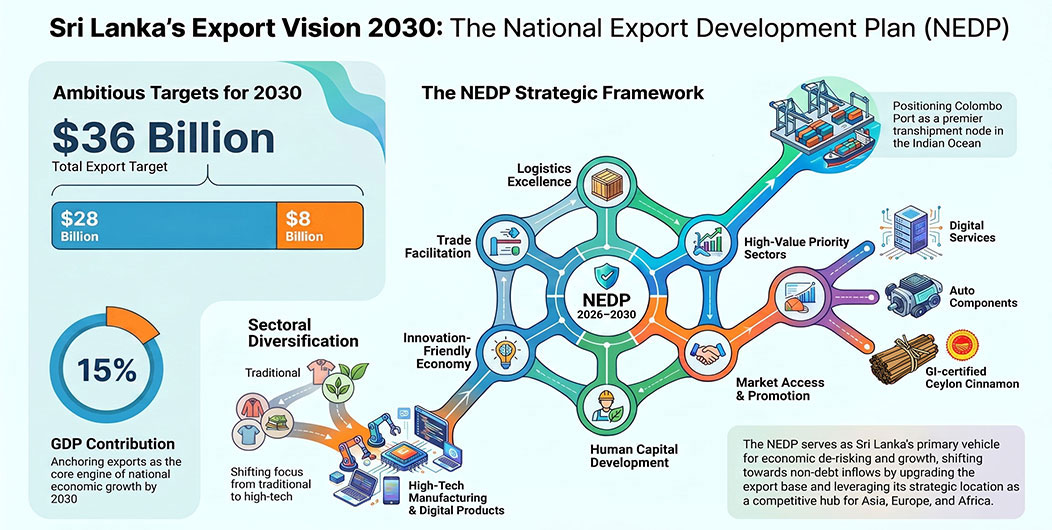
The Government of Sri Lanka has articulated a forward-looking trade development agenda focused on expanding and upgrading the export base, integrating into regional and global value chains, and positioning Sri Lanka as a logistics and services hub. The NEDP 2026–2030 is the key implementation framework for achieving export-led growth and economic diversification.
Exports are positioned as the main driver of growth, with targets of 14–15% of GDP and USD 36 billion in total exports by 2030, comprising USD 28 billion in merchandise exports and over USD 8 billion in services exports.
“Sri Lanka : a competitive logistics and knowledge-intensive export hub, serving regional and global markets”
The Indian Ocean’s leading trade and logistics hub, with a knowledge-based, competitive and innovative export economy that delivers inclusive, sustainable growth.
Under the overarching vision of ‘Sri Lanka: a competitive logistics and knowledge-intensive export hub, serving regional and global markets’, the NEDP sets out six mutually reinforcing strategic objectives that provide a coherent framework for reforms and investments.







Sri Lanka benefits from its strategic location, expanding port infrastructure, and emerging logistics ecosystem. Colombo Port continues to strengthen its role as a regional transshipment hub, supported by logistics zones and multimodal connectivity.
Key export sectors include apparel, tea, IT services, spices, electronics, and marine-based industries. The workforce is relatively skilled, and sectors such as apparel employ over 300,000 workers. The services sector, particularly IT and tourism, is expanding rapidly.
The spices and concentrates sector offer strong value addition potential, supported by the GI certification for Ceylon Cinnamon, enhancing global competitiveness and branding.