Nearshoring refers to the practice of transferring business operations to nearby countries, typically to reduce costs while maintaining proximity for efficient supply chain management, cultural affinity, and time zone compatibility. For the automotive industry, a nearshore spare parts base provides regional manufacturers and markets with reliable, cost-effective component supply while minimising logistics complexities and lead times. Sri Lanka's geographic position, manufacturing capabilities, and policy environment position it as an emerging nearshore hub for South Asia, the Middle East, and Africa.
Sri Lanka's geographic positioning in the Indian Ocean provides unparalleled access to major automotive markets. The country sits at the crossroads of Eastern and Western trade routes, with proximity to India (the world's 4th largest automotive market), the Middle East and Africa (MEA automotive spare parts market valued at USD 13.36 billion in 2024), and Southeast Asian manufacturing hubs.
This central location enables efficient shipping to regional destinations within days rather than the weeks required from more distant manufacturing centres. Major ports, including Colombo, provide world-class transhipment facilities and connectivity to main shipping lanes, supporting just-in-time inventory management and reducing working capital requirements for buyers.
The geographic advantage is particularly significant for serving India's Tamil Nadu automotive cluster, with Sri Lankan manufacturers actively pursuing strategies to penetrate this massive regional market through preferential trade access and cultural affinity.
Sri Lanka's logistics infrastructure supports nearshore operations through modern port facilities with automotive-specific handling capabilities, efficient customs clearance processes for export-oriented manufacturers, dedicated industrial zones with integrated logistics support, and partnerships with global logistics providers, including DHL Express, offering competitive transit times.
The country's free trade agreements provide duty-free or preferential access to key nearshore markets: 100% duty-free access to India for automotive components (except rubber parts), 60% duty-free access to Pakistan, and 100% duty-free access to EU markets, significantly enhancing cost competitiveness versus alternative nearshore locations.European markets including Germany, Belgium, Czech Republic, Netherlands, France, Sweden, and the UK represent established export destinations.
Express shipping capabilities enable Sri Lankan manufacturers to serve global customers without requiring large warehousing operations abroad, a critical advantage for nearshore positioning. For example, custom brake components can be delivered to Dubai-based distributors or Indian workshops within days, providing responsiveness competitive with domestic suppliers.
Labour costs in Sri Lanka are significantly lower than in developed markets, approximately USD 4 per hour compared to USD 100 per hour in markets like Australia, while maintaining skilled workforce capabilities. This cost structure enables competitive pricing that attracts nearshore partnerships from higher-cost regional manufacturers.
Manufacturing costs for components remain competitive versus other potential nearshore locations, with an added advantage being the availability of natural resources, particularly rubber for automotive applications, and an established industrial infrastructure. Enhanced capital allowances and investment incentives further improve the total cost of ownership for companies setting up nearshore operations.
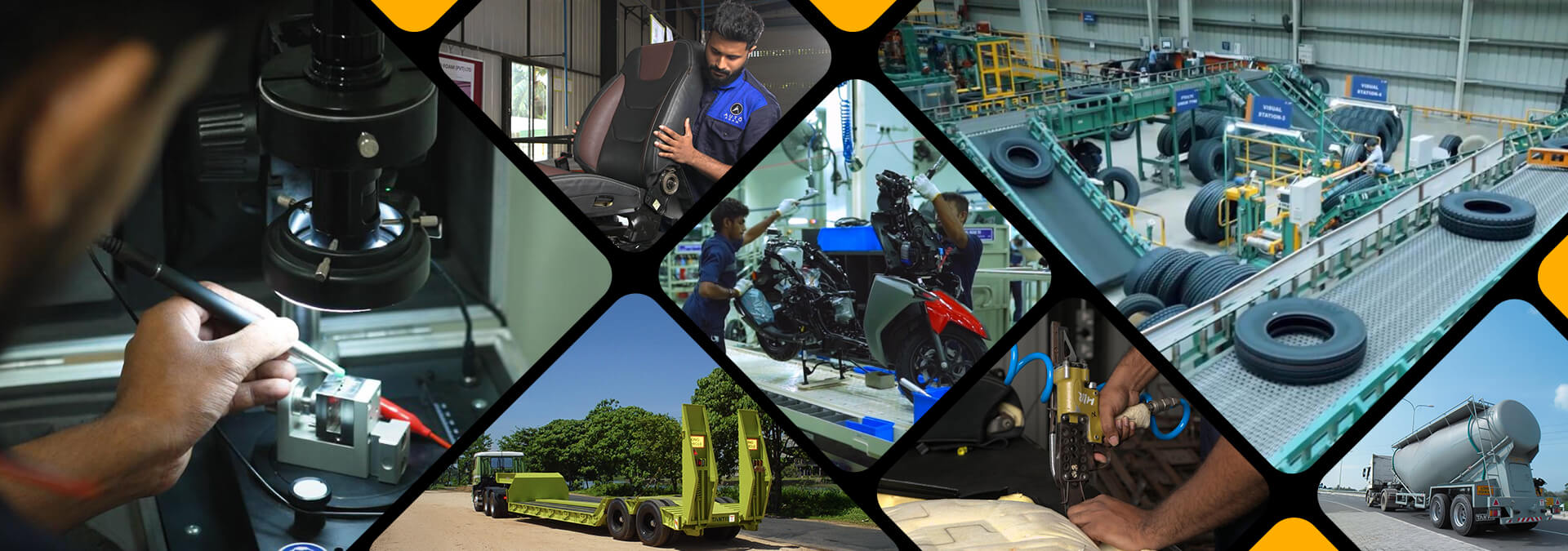
Sri Lanka's automotive part manufacturing sector comprises approximately 50 established companies employing over 18,000 workers, demonstrating capacity and reliability for nearshore partnerships. The sector's proven ability to supply safety-critical components to premium global brands (Toyota, Honda, Aston Martin, BMW) validates quality assurance capabilities essential for nearshore operations.
Product diversity spanning rubber components, electrical systems, mechanical parts, safety systems, and body components enables comprehensive nearshore solutions rather than single-product sourcing. Current export performance of USD 800 million annually demonstrates scale potential for expanded nearshore relationships.
Nearshore viability depends on quality assurance, where Sri Lankan manufacturers increasingly achieve IATF 16949 certification, the global automotive quality management standard. Government support covering 50% of certification costs accelerates industry-wide capability development.
Compliance with international safety standards, environmental management systems (ISO 14000), and destination market requirements, such as Australian Design Rules for conversion operations, demonstrates readiness for demanding nearshore partnerships.
The Standard Operating Procedure mandating local value addition in vehicle assembly creates structured demand for nearshore part supply to domestic assemblers, including Hyundai, Mahindra, and TATA, establishing proof-of-concept for expanded regional nearshore relationships.
Planned R&D and testing facilities, dedicated industrial zones, and the 20-year master plan for automotive manufacturing signal long-term government commitment to infrastructure and policy stability essential for nearshore partnerships requiring multi-year investments.
Companies seeking to establish Sri Lanka as a nearshore spare parts base can pursue several approaches: direct partnerships with existing component manufacturers through joint ventures or technology licensing, establishment of dedicated manufacturing facilities in industrial zones with government incentive support, development of contract manufacturing relationships where Sri Lankan suppliers produce to buyer specifications, or creation of regional distribution hubs leveraging Sri Lanka's strategic location and logistics infrastructure.
The Sri Lanka Export Development Board accommodates nearshore partnerships through investor identification and matchmaking services, support for feasibility studies and market entry strategies, coordination with regulatory authorities for approvals and incentives, and ongoing trade facilitation and market intelligence.
A combination of factors, including Sri Lanka's strategic location, established manufacturing capabilities, preferential market access, cost competitiveness, and government support, creates compelling value propositions for companies seeking reliable nearshore spare parts solutions for South Asian, Middle Eastern, and African automotive markets.
Sri Lanka is a fast-growing automotive manufacturing hub, offering global buyers cost-efficient, high-quality vehicles and components. With strong policy support, 50+ component makers, 30 assembly plants, and partnerships with leading brands like Hyundai and TATA, Sri Lanka ensures international standards, strategic location advantages, and supply chain resilience.