2026-09-21
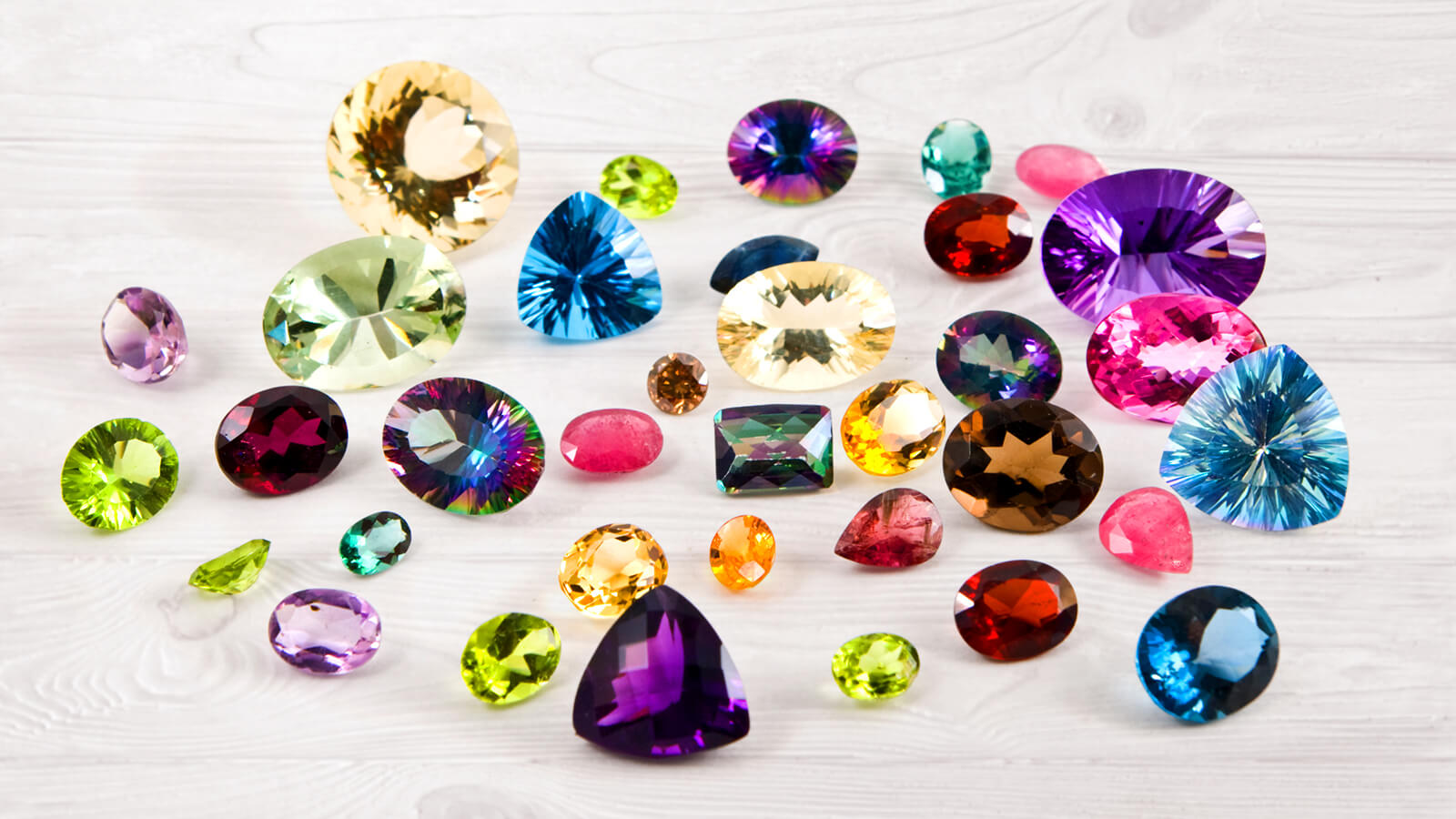
Sri Lanka, also known as the legendary "Isle of Gems," has been part of the global gem trade for more than two thousand years. Roman writers, Arab traders, and Marco Polo all recorded its stones in historical literature. Roughly a quarter of the island's land mass bars gems, and more than 75 varieties of precious and semi-precious stones leave the country each year. Today, that heritage meets a fast-expanding global market, and the Sri Lanka Export Development Board (EDB) is positioning the country's gem (H 7103), diamond (h7102), and jewellery (7113) sector to capture a much bigger share of it.
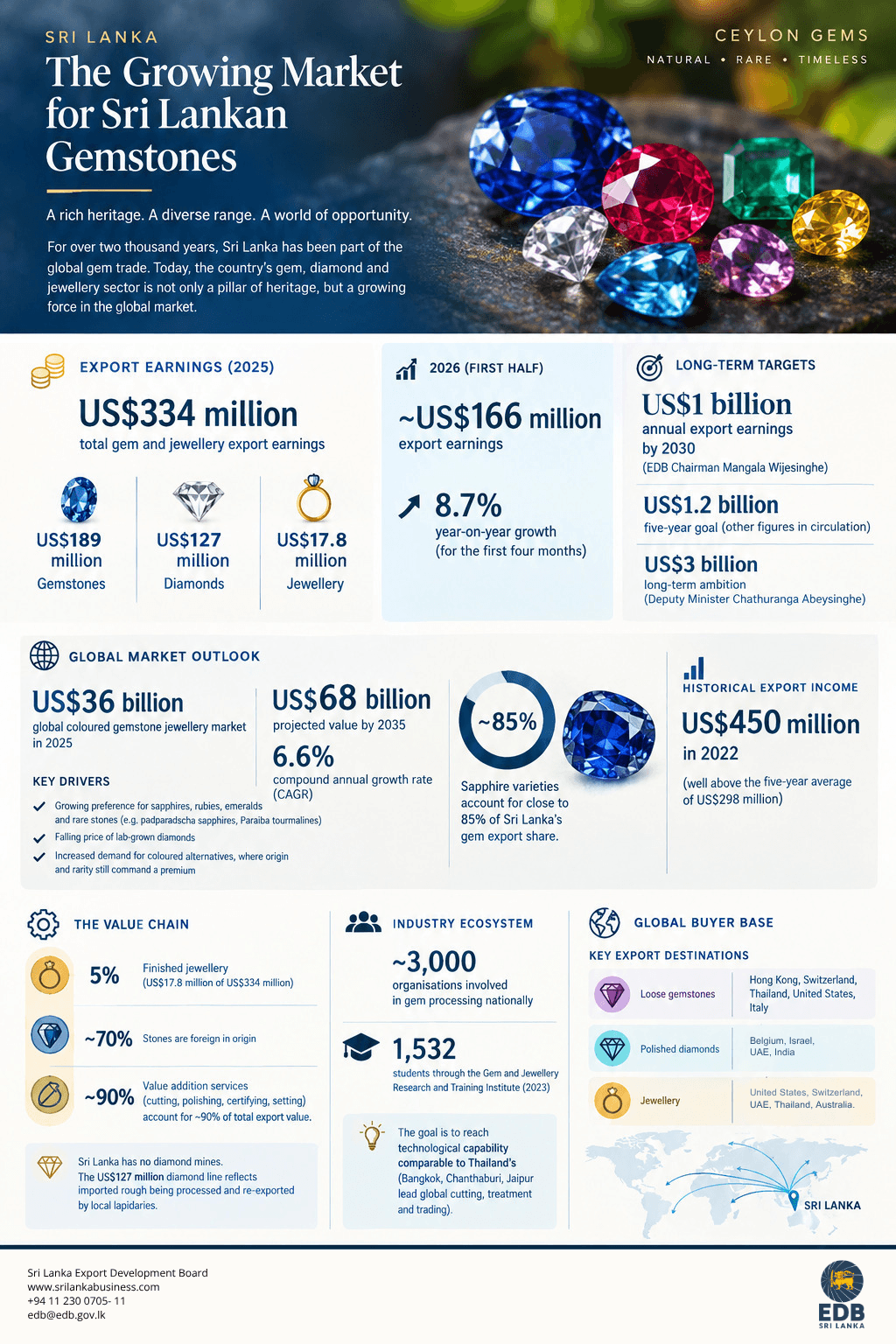
Sri Lanka's gem and jewellery industry generated US$334 million in export earnings in 2025, split across gemstones (US$189 million), diamonds (US$127 million), and jewellery (US$17.8 million). That momentum has carried into 2026, with the first half of the year alone bringing in roughly US$166 million, and the EDB reporting 8.7% year-on-year growth over the first four months of the year.
EDB Chairman Mangala Wijesinghe has set a target of US$1 billion in annual export earnings by 2030, a goal tied closely to “FACETS Sri Lanka” which EDB has co-organised since 1991 alongside the Sri Lanka Gem and Jewellery Association, “Gem Sri Lanka”; organized by Ceylon Gem & Jewellery Traders Association and “Gem City Rathnapura’; organized by National Gem & Jewellery Authority with the coordination of Lanka Gem Dealers and Miners Association. Other figures in circulation include a US$1.2 billion five-year goal. The Deputy Minister of Industry and Entrepreneurship Development Chathuranga Abeysinghe looks forward to a longer-term ambition of US$3 billion. Aside from those executions, the EDB's dedicated SME Jewellery Pavilion at Facets has been running since 1996, helping hundreds of small and medium manufacturers move into export markets.
The push comes at a favourable moment. According to EDB's own market analysis, the global coloured gemstone jewellery market was valued at approximately US$36 billion in 2025 and is projected to reach US$68 billion by 2035, growing at a compound annual growth rate of 6.6%. That growth is driven largely by consumers shifting away from traditional diamonds toward sapphires, rubies, emeralds, and rarer stones like padparadscha sapphires and Paraiba tourmalines. Sri Lanka has a distinct natural advantage in these categories. Sapphire varieties alone account for close to 85% of the country's gem export share.
Part of that shift is being accelerated by the falling price of lab-grown diamonds, which has weakened the natural diamond's hold as the default centre stone and pushed both buyers and brands toward coloured alternatives, where origin and rarity still carry a premium.
Historical data from the Central Bank of Sri Lanka shows just how much upside remains. In 2022, the sector's export income reached US$450 million, well above its five-year average of US$298 million at the time, showing that earnings can swing sharply upward when conditions align.
Finished jewellery accounted for just US$17.8 million of the sector's US$334 million in 2025. This accounts for about 5% of all export earnings. The bulk of Sri Lanka's earnings still come from stones themselves, not the finished pieces they end up in.
Around 70% of the stones Sri Lanka exports are actually foreign in origin, and value addition services such as cutting, polishing, certifying, setting account for roughly 90% of total export value. This is also what explains the US$127 million diamond line. Sri Lanka has no diamond mines. Therefore, that figure reflects imported rough being processed and re-exported by local lapidaries. In other words, Sri Lanka already functions as a processing economy capturing more of the value chain rather than just supplying raw stones.
Around 3,000 organisations are involved in gem processing nationally, supported by a training pipeline that puts 1,532 students through the Gem and Jewellery Research and Training Institute in 2023. Bangkok and Chanthaburi in Thailand, and Jaipur in India, dominate global cutting, treatment, and trading, drawing rough increasingly from African sources as well as from Sri Lanka. Deputy Minister Abeysinghe has said openly that the goal is to reach technological capability comparable to Thailand's.
Sri Lanka's gem, diamond, and jewellery exports increasingly flow through distinct, specialised channels. Loose gemstones head mainly to Hong Kong, Switzerland, Thailand, the United States, and Italy. Polished diamonds go primarily to Switzerland, Israel, the UAE, Belgium, and India. Finished jewellery sells best in the United States, Switzerland, the UAE, Thailand, and Australia.
This spread reduces the sector's reliance on any single market and reflects years of EDB-led buyer outreach, including a recent trade delegation to India aimed at deepening ties with Mumbai and Pune's jewellery trade bodies, where EDB has actively promoted Sri Lanka as a source of ethically produced gemstones and jewellery.
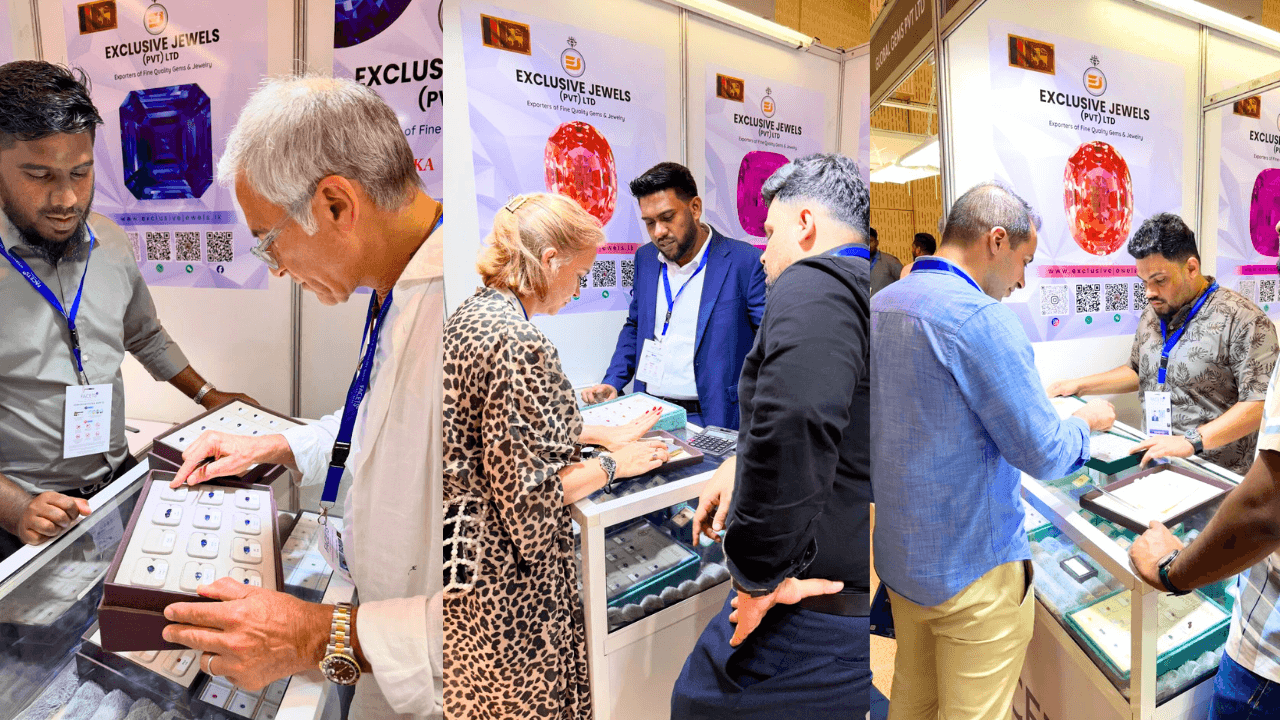
“Informality" is a structural challenge standing between Sri Lanka and its billion-dollar ambition. In April 2025, former NGJA Chairman put the scale of the problem plainly. That is, around 90% of gem exports still move through informal channels, leaving significant earnings unrecorded and unregulated.
That's beginning to change through concrete measures rather than just intent:
A few risks stand between the ambition and the outcome:
With upcoming platforms like Sri Lanka Expo 2027, running 14–17 January 2027 at the BMICH in Colombo and expected to connect local exporters with over 1,500 international buyers. Gem City Ratnapura is another exhibition that will anchor the sector in its historical heartland, and continued investment in branding Ceylon-origin stones, Sri Lanka's gem and jewellery sector is positioning itself for a sustained climb. The combination of rising global demand for coloured gemstones, a diversified buyer base, and a policy push toward formal, traceable trade gives Sri Lanka a credible path toward turning centuries of gemstone heritage into a modern billion-dollar export industry.
Exporters and manufacturers looking to access these platforms can register interest through the Sri Lanka Export Development Board at srilankabusiness.com, for guidance on export procedures and Expo 2027 participation.