2026-06-15
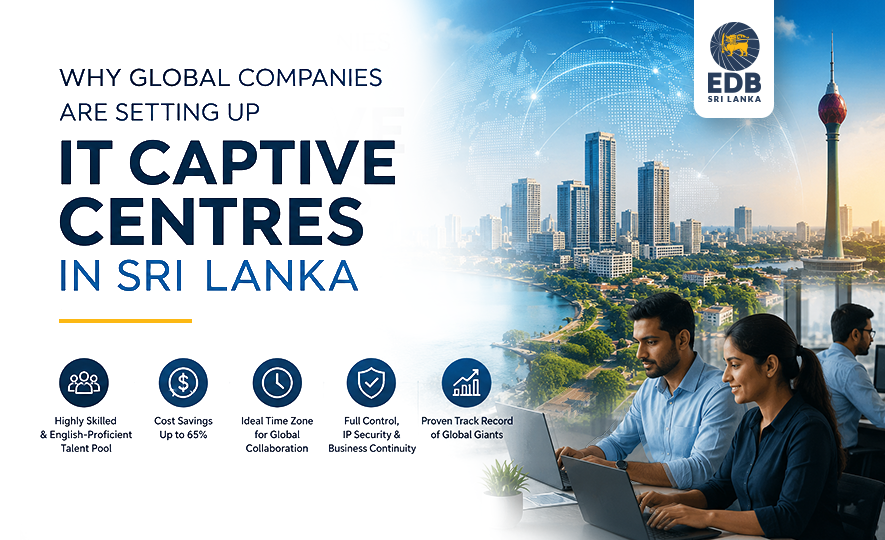
While Sri Lanka has long been celebrated for its tea, gems, and spices, the island's economic profile has undergone a significant transformation in recent decades. Today, Sri Lanka is rapidly establishing itself as a premier destination for IT captive centres, client-owned, offshore delivery operations through which global multinationals manage their technology functions directly, without third-party intermediaries. As decision-makers at multinational corporations (MNCs) increasingly scrutinise the trade-offs between outsourcing and direct ownership of IT capability, Sri Lanka has emerged as a compelling answer.
This article examines why global companies are choosing Sri Lanka to establish their IT captive centres, what structural advantages the country offers, and how the Sri Lanka Export Development Board (EDB) supports incoming investors.
An IT captive centre, also referred to as a global capability centre (GCC) or captive delivery centre, is an offshore unit wholly owned and operated by a parent company. Unlike conventional IT outsourcing, where a third-party vendor manages the delivery, a captive centre places all control, IP ownership, and talent management directly in the hands of the investing organisation.
The appeal of this model has grown considerably. According to global industry analysis, more than 300 new offshore and nearshore GCCs were established worldwide in 2025 alone, the second consecutive year at that level. Companies setting up captive centres cite three primary motivations: tighter control over intellectual property, the ability to build proprietary institutional knowledge, and long-term cost efficiency compared to sustained vendor contracts.
For MNCs with significant and ongoing IT requirements, particularly in software development, data analytics, cybersecurity, or finance technology, a captive centre offers a structurally superior alternative to outsourcing once operations reach scale.
Sri Lanka occupies a distinctive position among offshore IT destinations in Asia. While the country is smaller in scale than established hubs such as India or the Philippines, it has carved out a reputation for delivering high-complexity, high-quality IT services, a positioning that makes it particularly attractive for captive centre operations.
The country's ICT and business process management (BPM) sector has demonstrated consistent export growth. According to the Central Bank of Sri Lanka, IT-BPM export revenue grew 8.8% in 2025 to USD 1,645 million in official recorded figures, though industry experts note that the actual figure is substantially higher, as many companies invoice international clients through overseas entities in Singapore or Dubai, revenue that is not fully captured in domestic statistics. SLASSCOM, the industry's apex body, pegs the sector's aspirational export target at USD 3 billion, representing approximately 4% of national GDP.
A total of 25% of Sri Lanka's BPM providers operate exclusively as captive delivery centres, according to EDB data. Of the fully foreign-owned companies operating in the country, approximately 60% function as exclusive, client-owned service delivery centres, a figure that underscores the degree to which Sri Lanka has already become embedded in global IT captive centre strategies.
Global giants, including Sysco Labs, HSBC, and the London Stock Exchange Group (LSEG), have all chosen Sri Lanka as their preferred destination for captive centre operations. Notably, research cited by EDB Sri Lanka found that companies operating delivery centres across multiple countries, including HSBC and Copal-Amba, specifically prefer to locate their most complex operations and highest-value client relationships in Sri Lanka, rather than in other markets where they also have a footprint.

Sri Lanka produces more than 100,000 graduates annually, with a significant proportion specialising in IT, engineering, and business services. The country's developer talent pool now exceeds 150,000 professionals, and English proficiency is broad across the educated workforce, a legacy of the country's education system and its historical ties to Commonwealth markets. For MNCs whose operations and client bases are concentrated in the United Kingdom, the United States, Australia, or the Middle East, this linguistic and cultural alignment significantly reduces the friction typically associated with offshore operations.
Sri Lanka's talent has also earned a qualitative reputation. EDB research indicates that companies with multi-country delivery footprints frequently assign their most intellectually demanding work, complex software architecture, financial modelling, and advanced analytics to their Sri Lanka teams. This reflects not simply cost considerations but a recognition of the depth of the talent available.
The economics of operating in Sri Lanka remain compelling for MNCs evaluating offshore options. IT outsourcing and captive centre operations in Sri Lanka typically deliver cost savings of between 40% and 65% compared to equivalent headcount in the United States or the United Kingdom. Developer rates range from approximately USD 25 to USD 40 per hour, substantially below rates in North America and Western Europe, and competitive with comparable markets in Southeast Asia and Eastern Europe.
When compared directly with India and the Philippines, the two most prominent captive centre destinations globally, Sri Lanka offers a cost structure that is either equivalent or more favourable, combined with the qualitative advantage of a workforce with strong English communication skills and a lower attrition rate relative to larger markets. Explore why Sri Lanka is a destination of choice for ICT.
Sri Lanka operates on GMT+5:30, a time zone that creates productive working-hour overlap with both European and Asia-Pacific business hours. For European companies, Sri Lanka's mornings overlap with the close of business in Western Europe, enabling real-time collaboration during critical handover periods. For companies with operations across APAC and the Middle East, Sri Lanka offers near-identical time zone alignment, further reducing coordination overhead.
Sri Lanka's government has established a robust framework to attract and retain foreign IT investment, administered primarily through the Board of Investment (BOI) and supported by the EDB. Key incentives available to IT captive centre operators include:
Sri Lanka's government also released a formal national AI strategy in 2025, signalling a long-term commitment to positioning the country as a hub for advanced technology services. This development will further strengthen the talent pipeline available to captive centre operators in the coming years.
The presence of globally recognised organisations operating captive centres in Sri Lanka serves as a powerful proof of concept for companies evaluating the destination.
HSBC operates a significant delivery centre in Sri Lanka, and has publicly recognised the country's workforce as among its strongest globally for handling complex financial operations and technology functions.
The London Stock Exchange Group (LSEG) established an operation in Sri Lanka as part of its global technology delivery network, leveraging the country's financial technology talent to support group-wide systems.
Sysco Labs, the global food services and distribution company's Sri Lanka technology arm, supports IT and analytics functions across international markets.
Beyond these headline names, a broader ecosystem of IT services companies has established operations in Sri Lanka, including IFS, Intel, Motorola, WNS, RR Donnelley, Virtusa, Pearson, and Accenture, a concentration of global technology employers that has progressively deepened the country's talent pool and its familiarity with international enterprise IT environments. Browse the full ICT exporters directory.
The Sri Lanka Export Development Board (EDB) provides dedicated support for MNCs evaluating or establishing IT captive centres in Sri Lanka. Working alongside the BOI, EDB facilitates market entry by connecting investors with government incentive programmes, qualified local partners, and sector-specific information to support the establishment process.
For global companies at the research or feasibility stage, EDB offers direct engagement with its ICT sector team, providing data, introductions, and on-the-ground guidance to reduce the complexity and timeline of establishing a captive centre operation.Contact the EDB ICT team to get started.
An IT captive centre, also called a global capability centre (GCC) or captive delivery center, is an offshore subsidiary wholly owned by the parent company, established to deliver IT and business functions directly rather than through a third-party outsourcing vendor.
Sri Lanka offers cost structures comparable to India, combined with higher English proficiency across the workforce, lower attrition rates in many roles, and a cultural alignment with Western markets that MNCs frequently cite as a differentiator. Research also shows that companies operating in both countries often assign their most complex work to Sri Lanka.
Qualifying IT operations can access tax holidays, 100% FDI allowance, full profit repatriation rights, and access to purpose-built tech park infrastructure. The BOI administers the primary incentive framework, with EDB providing facilitation support.
Notable examples include HSBC, the London Stock Exchange Group (LSEG), Sysco Labs, IFS, Intel, Motorola, Accenture, and Pearson, among others.
The recommended starting point is engaging with EDB Sri Lanka's ICT sector team, which can provide market entry data, facilitate BOI incentive applications, and connect investors with relevant on-the-ground resources.